This post was originally written on 23 August 2025 and published on my old blog I had created on Wix. I didn’t know Wix was an Israeli company. I am now boycotting Wix for the reasons you can find here. Free Palestine.
I find it interesting that the official song of the 2010 FIFA World Cup that took place in South Africa samples a song from Cameroon. I haven’t been to South Africa, but based on Instagram feeds and second-hand accounts, I feel confident saying: Cameroon and South Africa don’t exactly look alike. It might also be a latent message on something that deeply frustrates me: the habit of thinking of Africa as one small, interchangeable country, rather than a vast and wildly diverse continent.
But to be fair—was I any better a year ago? Probably not. Sometimes I forget how lucky I’ve been. In the past 10 months, work has taken me to four African countries, each totally distinct. It’s been a ride: moments of awe, moments of “get me out of here,” and everything in between. As this chapter wraps up (or maybe it already has?), I’m taking a moment to reflect. So here I am, sharing some thoughts, and hoping people might finally stop saying they “bless the rains down in Africa” just because they went on a safari. (Yes, I’m jealous—I haven’t seen a single wild animal on these trips.)
So where is it that I have been?
Well, I went to Morocco in 2019, but that doesn’t quite fit into what I want to talk about here. My first real encounter with sub-Saharan Africa started when my friend Marianna announced she was leaving London for Mozambique. I had to google where it was—and I’m not entirely sure I knew which continent it was in. Her leaving party featured dreamy videos of beaches, wildlife, and stunning landscapes. That was enough: I wanted in. I was determined to visit her. But, as life tends to do, plans shifted and I shelved the idea—visiting my friend in Africa felt unlikely. Or so I thought.
A few months into a new job, I started working on a project in Dar es Salaam. I didn’t travel there, but just being able to scratch Tanzania off my projects map was already exciting enough. Things escalated quickly when my manager announced we’d won a large healthcare waste project that involved “quite a bit of travel to developing countries”—at least the ones our corporate risk policies let us go to. When I was assigned Cameroon, I was told I’d likely have to travel. Naturally, I googled “Cameroon animals” and saw elephants and various apes. I was thrilled. And there were more countries involved.
Around the same time, I was asked to travel to Pemba—in actual Mozambique. Pemba’s in the north (Cabo Delgado province), while Marianna had been in the south (Maputo), but still—I was going! In the end, Mozambique really became the first sub-Saharan country I visited, back in September last year. A month or two later, I made it to Cameroon for the first time. Then came Benin in December. At that point, things started to feel a bit much, if I’m honest.
I was supposed to go to Angola in January, but who knew how tricky getting a business visa for Angola could be? Instead, I went back to Cameroon in May—Cameroon never ceases to surprise (and disappoint). Finally, in July, I made it to Angola. That’s when I thought: I’ve seen so much variety (just not a single wild animal), maybe it’s time I write some of it down.
When talking about my experience, I will tell you this in the same order the police stamps your passport at border control: random. It’s actually going to be an almost chronological order, with the exception that Cameroon will be last instead of second. It’s partly because I’d rather start with the good before getting to the challenging part, and partly because, deep inside, Cameroon is the real reason I’m writing this blog post.
Mozambique
I was meant to travel to Mozambique with a now-ex colleague from Costa Rica. Someone decided that since he spoke Spanish and Mozambique speaks Portuguese, potato, potahto, it was basically the same thing and he’d be my “language support.” OK boomer. In the end, his visa fell through, so I went solo. I probably wouldn’t have done it had Marianna not been there.
Things started going wrong the moment I landed in Maputo. At baggage claim, a man in some sort of uniform asked for my passport, handed it back with a half-smile, and a note from Qatar Airways: my luggage was still in Doha. Great start. After an endless lost-luggage report, they sent me off with a vague “We’ll be in touch.” Too bad I didn’t have any formal clothes (or generally no other clothes) for a meeting at the Ministry of Environment the next morning. Marianna, being the kind person she is, came to rescue me within half an hour and drove me to perhaps the only shop for Westerners in Maputo. Let me tell you something: as a small Sardinian, finding clothes in Mozambique is not easy. I eventually found something wildly overpriced (supply and demand, you know) but at least I was sorted.
The next day, after my meeting, Qatar Airways emailed: my luggage had arrived. Too bad I lost my wallet on the way to the airport. People always ask me if I’m sure it wasn’t stolen, but I am 100% sure. The overpriced skirt for a small westerner I had bought had no pockets, and when leaving one car to move into a taxi to get me to the airport, my wallet fell on the pavement. Thankfully, I’d left a spare debit card in my hotel room (life-saving hack).
Then came my favourite part of this story: while I was cursing at myself in my hotel room, reception called – someone had found my wallet, seen my Italian driving licence, and taken it to the Italian Embassy. The Embassy staff noticed my hotel key card inside, phoned the hotel, and told me to come collect it. I couldn’t until I returned from Pemba a few days later, but when I did, even the Embassy staff were shocked. They asked if I knew the man, why he hadn’t just taken the cash and used the cards. The answer is simple: nice people exist. And because of that man, I’ll never be able to say anything bad about Mozambique.
Mozambique, like the other ex-Portuguese colonies in Africa, gained its independence in 1975. This came with a lot of blood and, as usual, a civil war. Until then, many Portuguese families lived there, but most left after independence. Not so for the family of the woman I worked with on this project. Possibly the tallest woman I’ve ever met—blonde, light-eyed, and proudly born and raised in Mozambique—she had a fascinating story, but I don’t want to digress. I got the feeling that locals don’t consider her as “truly” Mozambican because of her Portuguese heritage, but she could absolutely drive like a Mozambican, which, frankly, made me feel safe.
We flew to Pemba together. I won’t lie—I was nervous. At the time, the UK Government’s travel advice had all of Cabo Delgado Province under an ‘Advise against all travel” warning, except for the city of Pemba. When I landed, I saw army helicopters and UN vehicles, which didn’t exactly calm me down. But Pemba turned out to be a beautiful coastal city facing the Indian Ocean with major problems: waste management being one of them. The issue was worsened by an influx of refugees from the rest of the province, fleeing conflict. That’s a bigger story—one I was meant to write about elsewhere so if I ever a) finish it, and b) get it published, I will link it here. What struck me most was how determined people were to make a change. In all honesty, they deserve it and I hope they get it. Other memorable notes from Pemba: I tried cassava for the first time, and also piri-piri—the hottest thing I’ve ever tasted. One tiny bite and my mouth was on fire.
Back in Maputo, I could finally see a bit of the capital. From what I saw, it’s a vibrant city where expats seem to slot in easily. I saw the train station where a scene from Blood Diamond was filmed, which was a good reason to have pictures of Leonardo Di Caprio everywhere (I have since watched the movie but I’m not sure I could identify the scene). I then walked to the market discovered that Mozambique is the world’s largest producer of cashews – and I love cashews. I then visited a park with tonnes of bats and Bougainvillea that my mum would have loved.
Walking with Marianna and her boyfriend, I felt safe—although to be fair, they knew exactly where they were going. But also, they confirmed they generally felt safe. Overall the vibe I got from Maputo was that it was a fairly international city, with a good expat community where you could live a nice life, if the money allows you to.
Less than a month after my visit, FRELIMO won the elections, again. It is the only party that has ever been in power since Mozambique’s independence. The win sparked protests that lasted until March 2025, leaving 22 security forces dead and many more injured.
I don’t know what’s happening in Mozambique now. I doubt my Pemba project will progress. I just hope people there will one day see the change they deserve—and that Pemba can make the most of its beauty.
Benin
Truth be told, I hadn’t been looking forward to Benin. I was nervous — worried the people I’d be working with wouldn’t be pleasant, that I’d end up trapped in my hotel feeling claustrophobic and useless, my work dismissed simply because I’m a female European (this is a consequence of my experience in Cameroon – I know you’re curious now but bear with me). I wasn’t even responsible for the project in Benin; I was going as technical support for my colleague Emily who had endured two weeks in Cameroon with me. I owed her.
Luckily, I was dead wrong. From the moment I landed in Cotonou, I looked out of the plane window and felt oddly at home. It reminded me of flying into Cagliari and seeing Elmas with its neat rows of residential blocks. I even spotted a Corsair plane and briefly thought there were direct flights from Corsica to Benin — a quick google research showed I was wrong, but it did mean Benin was a fairly popular tourist spot for the French, mostly of retired age.
The hotel was close to the airport. It was December, and to my surprise, the main road had Christmas lights — snowmen and Santa Claus in Africa felt surreal, but it was a nice vibe. Cotonou was definitely westernised, but in a comforting way. The hotel itself wasn’t glamorous, but it was clean and comfortable, and I slept almost like a baby — something I hadn’t expected. Everything felt far less intimidating than I’d imagined.
Work started with our first stakeholder engagement session at the US Embassy to meet USAID. On the wall there was a portrait of Biden, and I felt uncomfortable at the thought that soon it would soon be replaced by Trump’s face. What I would never have imagined, though, is that USAID itself would be suspended: when my colleagues went back to Cotonou less than three months later, USAID was gone.
Work went smoothly overall. People were warm and lit up when they realised I could actually understand French. For the first time in my life (after 8 years studying French at school), I actually started speaking — asking questions, making comments and joining in conversations. People recognised I was making the effort and appreciated it, and their encouragement made me feel unexpectedly confident of my broken French. I’m still on Duolingo Max, still broken.
Our driver and his colleague really wanted us to make the most of our trip to Benin. We visited Cotonou’s landmarks — the Amazon Statue, the beach, the longest street art wall in Africa (unverified) — and the Temple of Pythons in Ouidah. I hadn’t planned to touch the snakes, not out of fear but because I wanted to leave the animals alone. But when the guide told me they eat mice and rats, I couldn’t resist: if my enemy is your food, then we’re friends. The Temple of Pythons is actually a Voodoo (Vodun) temple: Vodun is a recognised religion in Benin – if this doesn’t convince you that it’s a cool place, then I don’t know. I don’t remember much about the explanation, just the guide being annoyed about the negative connotation that Voodoo has in western culture, saying that what we saw in western medias isn’t what Vodun is about, and that this was a religion centred about doing good (aren’t they all?).
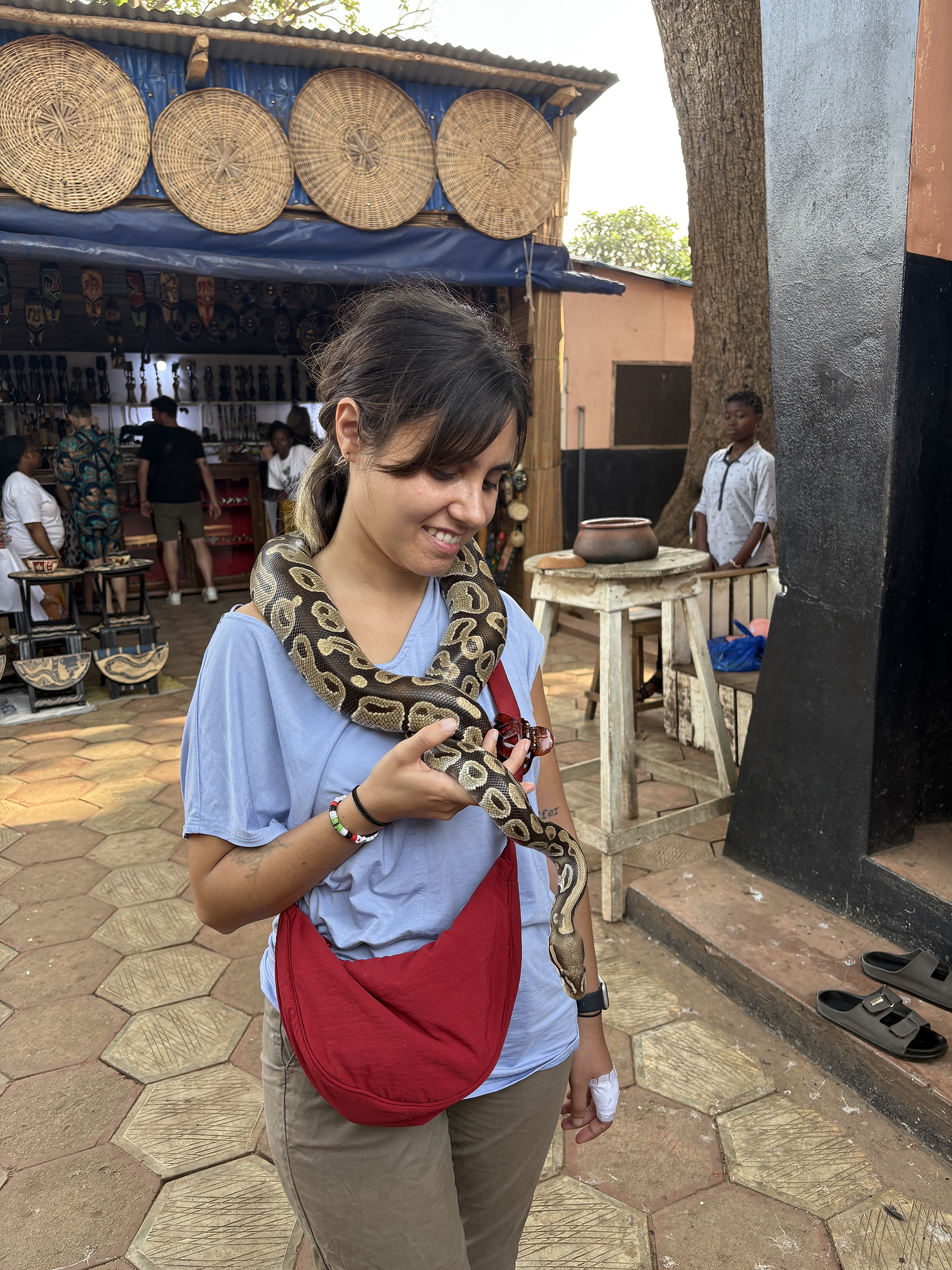
I left Benin thinking karma was real. The universe was paying me back from the bad experience I had in Cameroon. It wanted to show me that not all of West Africa is the same, not all ex-French colonies are the same and that travelling for work could still be good and worth it.
The cherry on the cake was the message I got from my aunt when I was back home, asking me how I found Benin and saying she had also been to Benin for work years ago. It instantly brought back a vivid memory of my 18th birthday dinner, when she was telling me and my friend about a project she did in some African villages to promote female entrepreneurship. I remember thinking back then that I wanted to be like her when I grew up — I guess this is close enough. When we met over Christmas, we compared our experiences of Benin, and I was pleased to find that, despite 15 years apart, we’d enjoyed it in much the same way.
Angola
In Pemba, Mozambique, I met a Dutch man who was delivering another part of the project. I was impressed by his fluent Portuguese and asked him where he learnt it. He said he had lived in Angola for years, but liked Mozambique more: Angolans could be cold and not very welcoming. I was really interested in Angola, for one main reason: the most badass, intimidating flag you will ever see. Still my favourite, I’m not going to lie. Personally, I think Angola and Mozambique are more similar to each other than to the other countries I’ve visited.
Well let me tell you that getting a visa to go to Angola is not easy. The first time I was meant to go, in January, I couldn’t because I was issued the wrong visa. The second time went better, but my Portuguese colleague who was meant to join the mission for language support, never got his, for reasons unknown. Europeans don’t need a tourist visa, so technically he could have travelled, but would you risk it in a country with a flag like that?
Angola is by far the most developed sub-Saharan African country I’ve seen. Parts of Luanda feel very European, and it seems that many Portuguese stayed after independence, unlike Mozambique. In restaurants, I often noticed people of different backgrounds sharing a table. Had I not been to Cameroon before, I probably wouldn’t have been so surprised.
I visited Luanda, Benguela, and Lobito. Some areas of Luanda are stunning: the National Assembly building is impressive, and the Marginal gives strong Cagliari vibes (I always notice anything that reminds me of my city). I’d love to return as a tourist. The skyscrapers were designed when Luanda was a contender to become the Dubai of Africa, reflecting Angola’s oil wealth, though this prosperity is unevenly distributed: extreme poverty sits alongside gleaming towers. This is why some parts of Angola are incredibly rich. This richness is of course never distributed evenly: there is extreme poverty next to some of those skyscrapers. From my hotel on a hill overlooking the Marginal, I watched kids play football every evening, making the most of life far better than many European children glued to their phones.
Another thing that struck me in Luanda was how smartly people dress — it gave me Milan fashion week vibes. Appearance really matters, and formality is the norm, especially in governmental jobs. I almost wasn’t allowed into the Ministry of Health building because I was wearing a sleeveless top: the security guard asked me where my jacket was, and when I said I didn’t have one, he told me I couldn’t enter showing tattoos. My colleague lent me her cardigan; otherwise, I would have had to go back to the hotel to get changed. Shocking.
Then, in Lobito, something magical happened: while I was waiting for our partners to collect us, I saw two groups of dolphins swimming in the ocean. At first I couldn’t believe it, so I ran across the hotel lobby screaming (in italian: CI SONO I CAZZO DI DELFINIIIII) and down to the beach to see them. I tried to record a video but the excitement was too much and I actually didn’t hit the record button. I guess somehow this must count as a wildlife encounter?
I would definitely be happy to go to Angola again, and maybe take some extra time for tourism. Angola, its oil economy, its long-standing MPLA rule (similar to Frelimo in Mozambique I suppose) have fascinated me. Also there’s some wildlife that can be seen not far from Luanda. I will definitely consider it in the future.
Work-wise, it certainly wasn’t my most successful mission. Communication issues meant we couldn’t achieve many of our objectives, but our days were nevertheless long and demanding. The thing is – despite this “failure”, I didn’t change my mind about the people and the country: Angola left me with a strong positive impression.
Cameroon (it’s long)
In case you didn’t get the hints from the previous sections, Cameroon was challenging, to say the least. Hence I left it to the end. I feel bittersweet talking about it. There is a massive disparity between how I felt in the other three countries I talked about and Cameroon. I have questioned myself where this comes from, whether it’s me, I have tried digging into the reasons why I have experienced what I experienced. There is no simple answer, but I have some ideas. But I’ll start with the facts.
After my first great experience in sub-Saharan Africa, I was excited to see more. A month after Mozambique, Cameroon was on the agenda: two weeks split between the capital, Yaoundé, and the Western Region, anchored in Bafoussam. I wanted to be optimistic, but it was clear that I wasn’t going to have a similar experience. Our relationship with the client’s partner in the country was fractious and the preconditions just weren’t promising. In fact, my trip wasn’t even confirmed until a week before departure.
The world was also giving me strong signals: my Royal Air Maroc flight was cancelled one hour before the scheduled departure, with no reason. At least I wasn’t travelling alone this time: misery loves company and drama is always better when shared. We switched to a night flight via Addis Ababa and arrived in Yaoundé eight hours later than planned.
I like comfort, so after the desperate journey I was so ready to relax at the Hilton, where we stayed for the first week. I shouldn’t have had big expectations. My white socks turned black almost instantly after walking on the carpet of my room, the darkest hotel room I have ever been in. I’m sure when it opened it was a majestic palace, but decades later, the shine had long gone. Midweek, water started leaking from the ceiling lights in the bathroom of my colleague’s room and the fourth floor had the very unique smell of sewage. Convincing the staff at reception to give my colleague another room was a bit of an effort, but we eventually made it.
As usual, the first step of the mission was a round of meetings with stakeholders, but back then I didn’t know the drill yet. We met with the client’s partner, explained our technical view of the problem and proposed solutions (not that they were thinking of listening to our advice). Then we headed to the ministry, where we waited two hours to be received and were promptly met with hostility because… we are European. I am omitting a lot of details on purpose, but it was made abundantly clear we weren’t welcome. Thankfully, the client pushed back and defended us, but as far as first impressions go, this was the worst welcome I’ve ever had. If I ever get another one like it, I might just turn around and leave.
After a working week desperately trying to make our stakeholders respect us as technical advisors (liking us would have been a step too far), the weekend arrived. In reality, we only had the Saturday off, so we made sure to start our ”weekend celebrations” on Friday night. We tried to relax the only way we could: by enjoying what the Hilton had to offer.
There was a band performing in the restaurant, but no one seemed interested, which made it awkward. Funny enough, they were mostly playing international pop songs. The singer was actually quite good but the atmosphere was flat. So we decided to move to the bar on the 11th floor.
It could have been the start of a joke: a millennial (me), a Gen Z (my colleague), and a Gen X (our technical expert) walk into a bar in Yaoundé. We were all women. The vibe was far from funny: most tables were occupied by white men in their 50s, surrounded by Cameroonian women in their twenties, dressed in designer clothes. It was clearly very transactional. We later found out we weren’t the only ones to notice the endorsed prostitution at the Hilton. The music wasn’t great either, so the millennial and the Gen Z called it a night. The Gen X stayed behind, only to report later that the place quickly descended into something that felt more like a brothel.
The weekend didn’t get any better when we tried to visit the ape sanctuary on the outskirts of Yaoundé. The hotel staff organised a “taxi,” but about ten minutes into the journey, the driver casually informed us that the sanctuary required advance booking and that the next tour was three hours away. We turned back, frustrated, only to be told by the hotel staff that their plan had been to drop us off and pick us up after the tour — leaving us to wait, alone, in the jungle for hours. And this is the story of how I’ve never seen a monkey in the wild.
On Sunday we drove to Bafoussam in a convoy. Halfway through the trip, our partners that were travelling with us decided to stop in a village on the way. Nobody bothered to tell us what was going on. We were left sitting at the back of the car, unsure whether to get out or stay put. The car wasn’t locked, the keys were still in the ignition, and we didn’t want to risk leaving it unattended. Meanwhile, a crowd gathered, curious to peer in through the tinted windows. Perhaps they thought we were someone important; in reality, we were just three nobodies working on a waste management project. It couldn’t have been more than ten minutes, but the uncertainty made it feel like much longer – uncomfortable and tense.
When we reached Bafoussam, the hotel was nicer than the Hilton (which doesn’t take much), and we finally had a chance to relax. The Western Region felt very different from the Centre. For some reason, the first thing we were told was that polygamy is very common – I’m still not sure why our partner thought this was relevant information. The landscapes aren’t necessarily different, but it’s less densely populated, with more villages and distinct architecture: traditional houses with pointed roofs contributed to the character of the villages.
Unlike the Central Region, where we stayed mostly in Yaoundé, here we were constantly on the move. We drove for miles through lush scenery: green mountains, dense vegetation stretching to the horizon, quiet roads winding uphill and downhill. It felt peaceful and remote, and it quickly became my favourite part of Cameroon. If I ever go back, I hope it’s to the Western Region.
One moment, in particular, has stayed with me. While visiting a hospital in Dschang, I couldn’t tell if a staff member was speaking to me or to the ministry employees accompanying us on the mission. I asked one of our partners for an explanation, and what she told me shocked me: the head nurse was raising concerns about the increasing number of women coming to the hospital to give birth, then refusing to recognise the babies as their own and leaving them behind as orphans. It is still the most heartbreaking thing I have ever heard.
I came back from Cameroon relieved and, honestly, happy to be home. On the journey back from the airport London looked more beautiful than it ever had since I moved there. But when May came and the time to return approached, I was oddly optimistic. I semi-arrogantly thought I had figured Cameroon out, and I knew exactly what to do.
The second trip lasted only a week and was split between site visits in Douala and meetings in Yaoundé. Yaoundé is the political capital, but Douala is the largest city and financial centre. I had high expectations for Douala: I imagined a busy, international port city, perhaps as vibrant as Cotonou. In reality, the only sign of international influence I noticed was the Chinese district.
I can’t believe I have gone this far into this blog post without mentioning China! I am no expert in international relations (maybe I should have made this clear from the beginning so hear me out now: I’m only an expert in waste management and Green Day) but, in a nutshell, China is a major trade partner for most African countries. However, China is obviously much richer and more powerful than probably every country in Africa. This leads to an imbalance that results in big loans to finance projects, leaving countries with better infrastructure (see the Maputo bridge as an example, which has massively shortened travel distances to South Africa) but also massive debts. It’s been described as a form of neocolonialism.
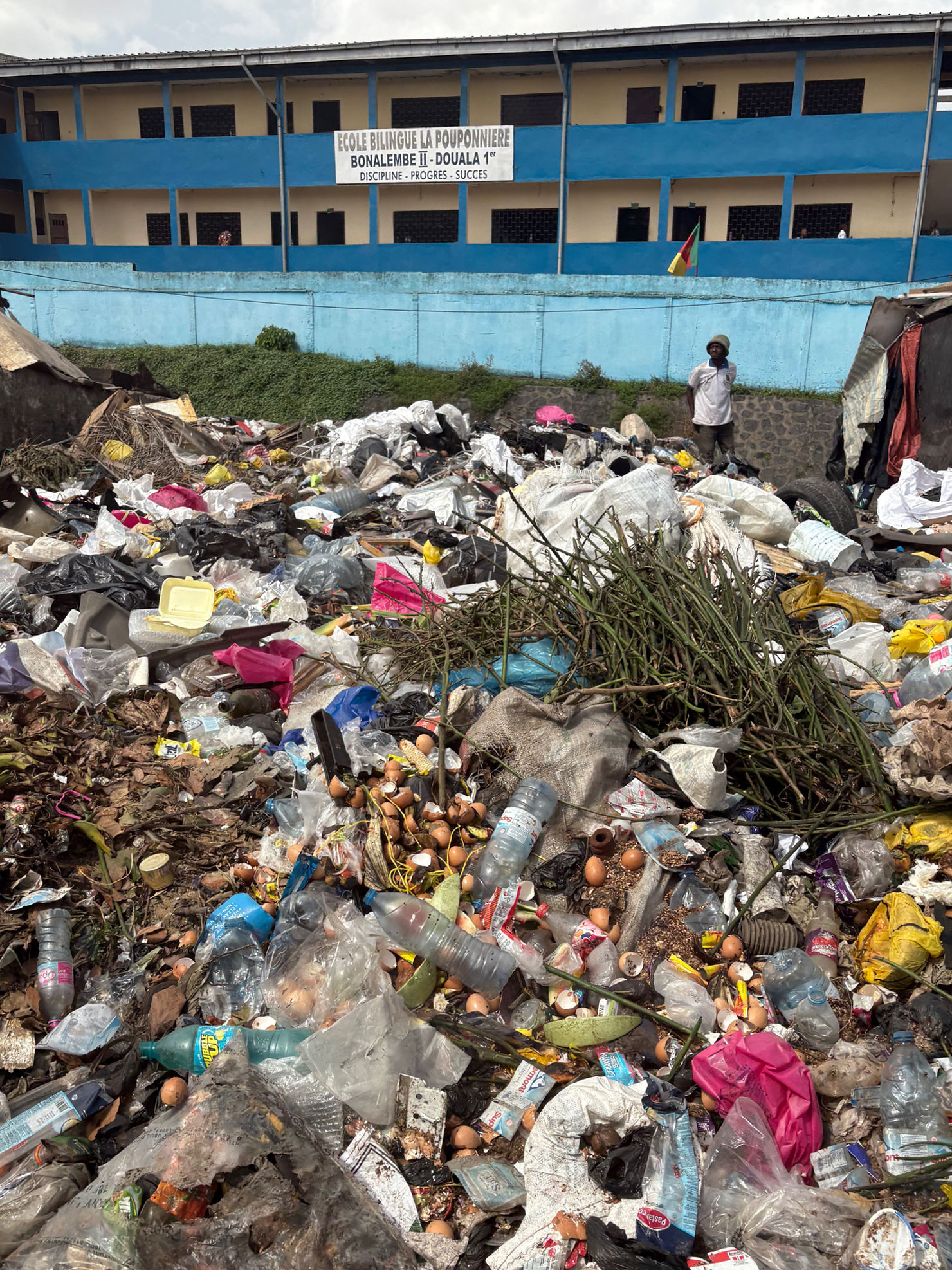
Other than the Chinese district, I found Douala busy but sad. From my room on the 8th floor of the Ibis I stayed at (oh look, an international brand! Not the typical Ibis standards though) I looked out over a city that seemed colourless. Interestingly, I could also see some large buildings abandoned mid-construction. It didn’t feel very vibrant, other than the traffic and the noise and the bumpy roads – I’m still surprised we didn’t have a single accident. Also, waste management practices in Douala were possibly the worst I have ever seen. The entire city is just an open dump, with rubbish piled high on the streets and clogged waterways; I’m not sure they have waste collection services at all.
The biggest surprise from this second trip was to be glad to be back at the Hilton in Yaoundé. My Gen X colleague was with me again, and perhaps because Douala had disappointed us so much, we welcomed the familiarity and space of the Hilton. What were we even complaining about the previous time?
I wanted to skip the part about our local partners failing to organise the stakeholder engagement sessions (the main reasons why we were in Yaoundé), but it links very well to an important point: after this trip, I promised myself I’d only return to Cameroon if absolutely necessary. From a work perspective, it felt like a waste of time and resources. If I were a donor, an aid agency, or a charity, I’d rather invest in a country more prepared to make use of the given support.
What do I mean by the country being prepared? First of all, understanding what the project really is, including its scale and implications. In the case of Cameroon, as a technical advisor in this project I repeatedly warned that the infrastructure they wanted to procure was largely oversized and raised concern about the operating costs that would be associated with it. I was met with some sort of arrogance and my concerns were ignored. I have wondered for a long time why this happened in Cameroon, but not in other countries.
When I was in Benin, I couldn’t help by compare the two countries: both ex-French colonies, both gained independence in 1960, yet so different. I think I got closer to an answer when I found out something very important: since independence, Benin has had 8 different presidents from 5 different parties; Cameroon has only 2 presidents, from the same party which has simply changed name (their logo is a flame, like Italy’s dead MSI which was then used by Brothers of Italy – that says a lot). Paul Biya has been the country’s only president since 1982, making him the longest serving president in the world.
I strongly believe this political stagnation has impacted Cameroon’s development, massively. It actually makes me feel bad for the Cameroonians. I believe the country’s corruption perception index score would benefit from a real political change. I believe the project I’m working on and the countless infrastructure projects that have failed in Cameroon would benefit from it. And ultimately, of course, Cameroonians themselves would benefit from a real democracy, not just on paper.
As of today, Biya is 92 and one of the approved candidates for the presidential elections scheduled for 12 October 2025. His main opponent has been barred from running, and the rest of the opposition is fragmented. Chances are he will win again. But this might really be a turning point in Cameroon’s history.
By now, it goes without saying that my experiences in Cameroon haven’t exactly been positive. This country has been a black sheep in my project, but I listened to a lot of Minor Threat as a teenager and I believe in black sheep. For me, seeing this country changing and grow would be one of the few things that could restore my faith I have in this world.
(Also off topic but there are only two African countries that have not recognised Palestine as a state. Cameroon is one of them, Eritrea is the second).
Epilogue
Why didn’t I just write a blog post about Cameroon if that’s basically all I talked about? Because I don’t want to sound like someone who dislikes “Africa” — I don’t. I’ve made memories I’ll treasure forever, and these trips also made me appreciate just how brilliant some of my colleagues are (Emily, if you’re reading this, I already miss you!).
I’ve seen so much variety across the four countries I’ve visited, and while it’s unlikely I’ll see more for now, I’m grateful for how each trip has changed me and helped me understand myself better. It’s a cliché, I know, but when I think of everything that’s happened within a year, I still struggle to believe it. This wasn’t just travel, it was constant exposure to new places, cultures, and people. And honestly, who cares if I didn’t see a lion, giraffe, or zebra? That’s tourism, and you can pay for that. What mattered were the people I met and worked with — even the ones who drove me mad.
Looking forward to reading the Cameroonian news on 13 October 2025 (fingers crossed).
 Claudia