This post was originally written on 04 January 2023 and published on my old blog I had created on Wix. I didn’t know Wix was an Israeli company. I am now boycotting Wix for the reasons you can find here. Free Palestine.
Until last month, I only knew two people who visited Cuba. One was my uncle/godfather, who went on a beach holiday back in the 90’s but ended up falling in love with Havana. The second one was one of my closest friends, also one of the smartest people I’ve ever met, who visited Cuba in 2018 fascinated by what she read about it. She ended up hating Havana. Two clashing opinions from two people really close to me. I didn’t know who to believe.
This year, 2022, marked an important milestone for me: my 30th birthday. I was born and raised in Sardinia and I love the sun more than anything else. Being born in December, my dream was to spend my birthday on the beach. My remaining annual leave didn’t allow me to fly to south east Asia as I would have loved to, so I had to find an alternative destination on the other side of the world. One place small enough to be explored in a week, but that still had a lot to offer. What better chance to make my own idea about Cuba?
Here are some tips and reflections on the week I spent in Cuba.
The itinerary
Since COVID-19, there are no direct flights from London to Havana. I found out during my trip that there’s a weekly flight from Manchester and Varadero, but this wouldn’t have made things easier. It took us almost 24 hours to reach our casa particular in Havana, including a 5 hour layover in Madrid.
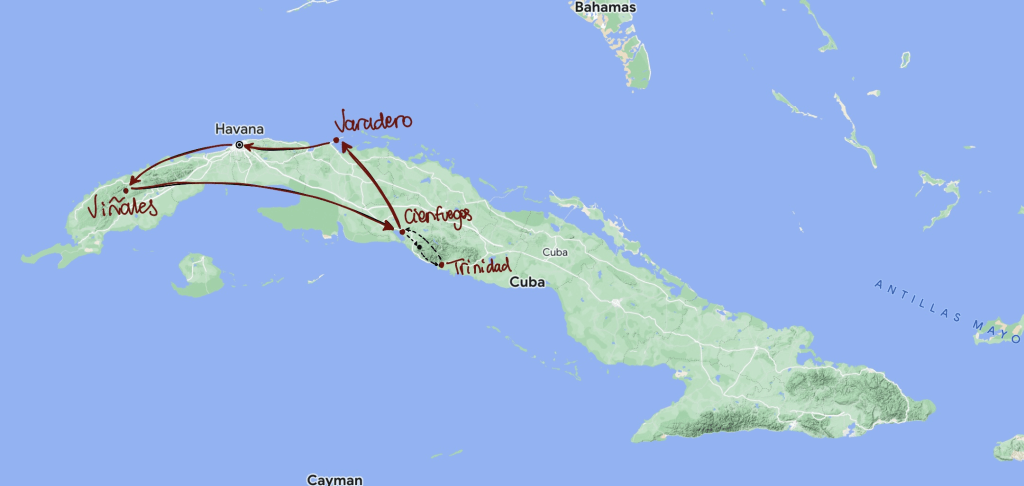
On our first day, we woke up early and spent one full day in Havana. This was enough time to walk around Habana Vieja and the centre, have our first Cuba Libre and get scammed to go to a not-so-Cuban festival.
The morning after our host booked us a taxi collectivo to the Viñales Valley. We spent one day and a half there. Our casa particular overlooked the green mountains, we did a walking tour and we wish we had known that was the most relaxing time our vacation had to offer.
We then went to Cienfuegos, an old French colony and somehow the most haunting place we visited. We were meant to spend two days there but, luckily, we managed to book a day trip to the waterfalls of El Nicho and Trinidad, a much more vibrant place.
We spent our last night in Varadero, famous for his resorts and golf courses. However, we stayed in a casa in the initial part of the peninsula and didn’t experience the mainstream tourism my uncle warned me about. To be honest, by then I was desperate for some non-Cuban food. We spent our last morning on the beach and our last evening in Havana, then left for the airport in the evening.
This time was enough to explore and get a sense of what the island, its people as its culture can offer. It was also enough to breathe and observe the everyday lives of Cuban, the political and social issues, and to reflect on what went wrong in their world and in ours.
Cuban food (as an ovo-vegetarian)
Before leaving I had documented myself as much as I could on “what to eat in Cuba as a vegan” (because, let’s be honest, who knows what an ovo-vegetarian is?). Some sources made me hopeful: rice, various vegetables, beans, tropical fruits. I thought I was fine. Maybe it wasn’t the best cuisine, but it was good enough. What I found was a bit different.
Most casas offer desajuno (breakfast) for €5 or $5. Yes, you read it right: it’s either euros or dollars. But we’ll get there later. The breakfast consist of some fruits, such as bananas, melon, pineapple and my newly favourite guava/guayaba. They also include some jugo (fruit juice), eggs and a slice of bread. I’m a big carb enthusiast, nothing makes me happier than pizza and bread, but Cuban bread is much less exciting. The toasts we’ve been served are worse than anything you’ll ever find in any European country. It lacks everything, from texture to taste, but mostly nutrients. Please note, this is not a criticism to Cubans – at all. They have to make do with what they have, I appreciate how they try their best and thank every host I’ve met for that.

Even with this downside, breakfast was the easiest meal of the day for me. I could at least have some proteins. Lunch and dinners were proper nightmares. In Havana I could consider myself lucky and have some decent rice with vegetables (arroz amarillo) and pasta that was okay (notes for vegans: by default any pasta comes covered in cheese, so you need to ask for pasta “sin queso”). But in other places, like Cienfuegos, even finding arroz Amarillo or arroz Moro became a struggle. Also, they tend to call vejetales what is actually cooked salad. Just look at my pizza with vejetales. There’s no tradition for vegan or vegetarian food as a main – these dishes are always sides. As such, they might not serve them on their own and make very little effort to offer a vegetarian meal.
Cubans have very few ingredients in their meals. My boyfriend is not vegetarian, but even he had limited choices. Rice, beans, green beans, onions and peppers dominate in pretty much every recipes. Salads consist of lettuce, cucumber, tomatoes (all cut very very thin, probably due to shortages). Once I got lucky and got some beetroot. Meat is chicken, pork and beef, mostly cooked in the same way. Cuba imports 80% of its food, but the current economic crisis and sanctions combined with logistics issues have had a negative impact on the food entering the country. My assumption is that it’s also impacted on the variety of food available.
My stomach shrunk considerably during my time in Cuba and I definitely wasn’t getting enough proteins during my days. If you’re planning to travel to Cuba and don’t eat meat or fish, make sure you bring enough protein bars with you. They might improve both your healthy and your holiday.
Money
Just talking about this makes me nervous, considering all of the misadventures we’ve had. So let’s start from the end: before you go to Cuba, estimate all the money you think you need, and withdraw twice that amount. Exchange them for euros (or dollars) if needed. Now you should be safe.
Until the beginning of 2021 Cuba officially ran on a double currency system. There was the Cuban convertible peso (CUC) and the Cuban National peso (CUP). Prices were shown in both currencies, with tourists theoretically only able to access to CUCs and charged like 20 times more. I won’t go into details as money is definitely not my thing, but here’s a nice article that explains things much better than I ever could.
Then COVID came. Tourism stopped. The crisis got worse. Trump doesn’t help. So the government decided to unify the currencies and the CUP became the only currency. The official rate was meant to be $1=€1=24 CUP, but on the black market you could get an 80 or 90 CUP for €1. This is what I had studied and this is what I knew.
What I didn’t know is that the Cubans don’t want CUPs. Forget about it. They’re desperate for euros (or dollars, if they really have to). The only thing I could easily pay in CUPs was some restaurant food. Everything else (taxis, breakfast, experiences, puros) can only be purchased in euros.
Also, the official exchange is a lie. Even at the bank. The actual bank exchange is $1=120 CUP and on the black market you can get up to 170 CUP for €1! But, of course, prices have also gone up. So at the end of the day, don’t expect things to be particularly cheap.
So what happens if you’re not up to date with Cuban inflation and bring the wrong amount of foreign cash with you? Let me tell you. I have been there twice. But first, let me tell you about how we got scammed.
On our first day in Havana, an old guy stopped us in Plaza Vieja to tell us how lucky we were because “Today is a special day in Cuba. There’s a big festival”. Like that, in English. This alone should have been a red flag, but what did we know? So when in the afternoon a friendly young couple started chatting with us about all-things-Cuba and they also told us about a big festival, we thought they were talking about the same one. The icing on the cake was when they said members of Buena Vista Social Club were playing, at which I couldn’t say no to my Cuban music lover boyfriend. Because of such a big name we even thought that paying €45 each was fair. It was definitely not accounted for in our cash budget, but we decided we would have dealt with this later. The “big festival” was a bunch maybe one hit wonder singers from the 50’s (aka las estrellas de los cinquentas), a 15-piece-band playing and an embarrassing group of European tourists dancing. Probably straight from a cruise ship. Despite being close to turning 30, I was probably the youngest person in the room. Talking to a Chilean couple met in a colectivo days later, we found out that’s one of the most common tourists scams. The second most famous is visiting the house of a member of the Castro family and meeting them.
Anyway, at this point we had €90 less in our budget and realised things were more expensive than we thought. We were worried about money, and rightly so. Once in Viñales, we knew we were at least €250 short to finish our trip. What we discovered is that, besides having unified CUCs and CUPs into a currency nobody really wants to deal with, the government has also introduced a virtual currency, the moneta libre convertible (MLC). €1=1 MLC. MLC saved our trip. After trying to book our next taxis collectivos online (these guys are your best hope), our host told us he knew someone who could help us. That’s how we found out about TropiPay: it allows unprepared tourists like us to transfer money through a link, this money is received as MLC, then whoever received the money can give it to you. You can receive approximately 80% of the money you transferred in euros (or dollars, I suppose). The app seems to be quite popular in Viñales, so make sure if you want to run out of money you do it here. Because the second time it wasn’t that easy.
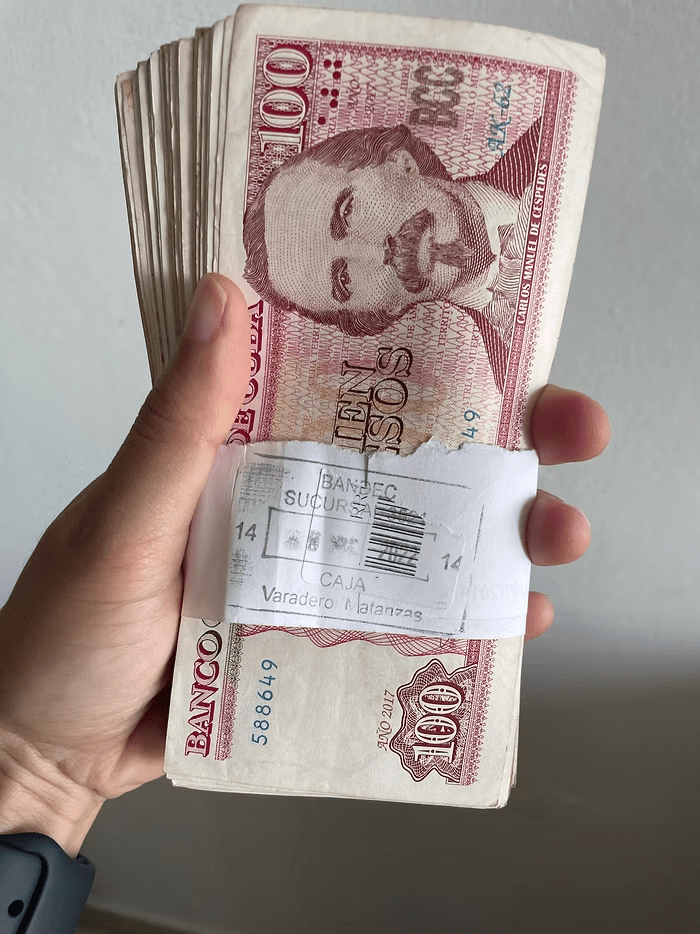
The second time, we ran out of money again because I was desperate to escape from Cienfuegos. We were in Varadero, which is meant to be the most western-friendly place in Cuba. I can’t speak about the resorts area, but if you stay where the locals live, your chances of paying by card and getting hold of foreign currency are quite low. This time, we had to queue in a local bank for around 30 minutes, show a passport and get Cuban pesos. We asked for 25,000 CUP, which we paid by card at an exchange of $1=120 CUP. Fun fact: we got the money in 100 CUP banknotes, leaving the bank with money bricks.
Paying in Cuban pesos is challenging, yet not impossible. On our way back to Havana, the quote for our taxi was €70, but we ended up paying 14,000 CUP, at an exchange rate of €1=200 CUP. If all you have is pesos, get ready to pay for a premium and explain that that’s literally all you have. Cubans are nice and will understand.
So is it all bad?
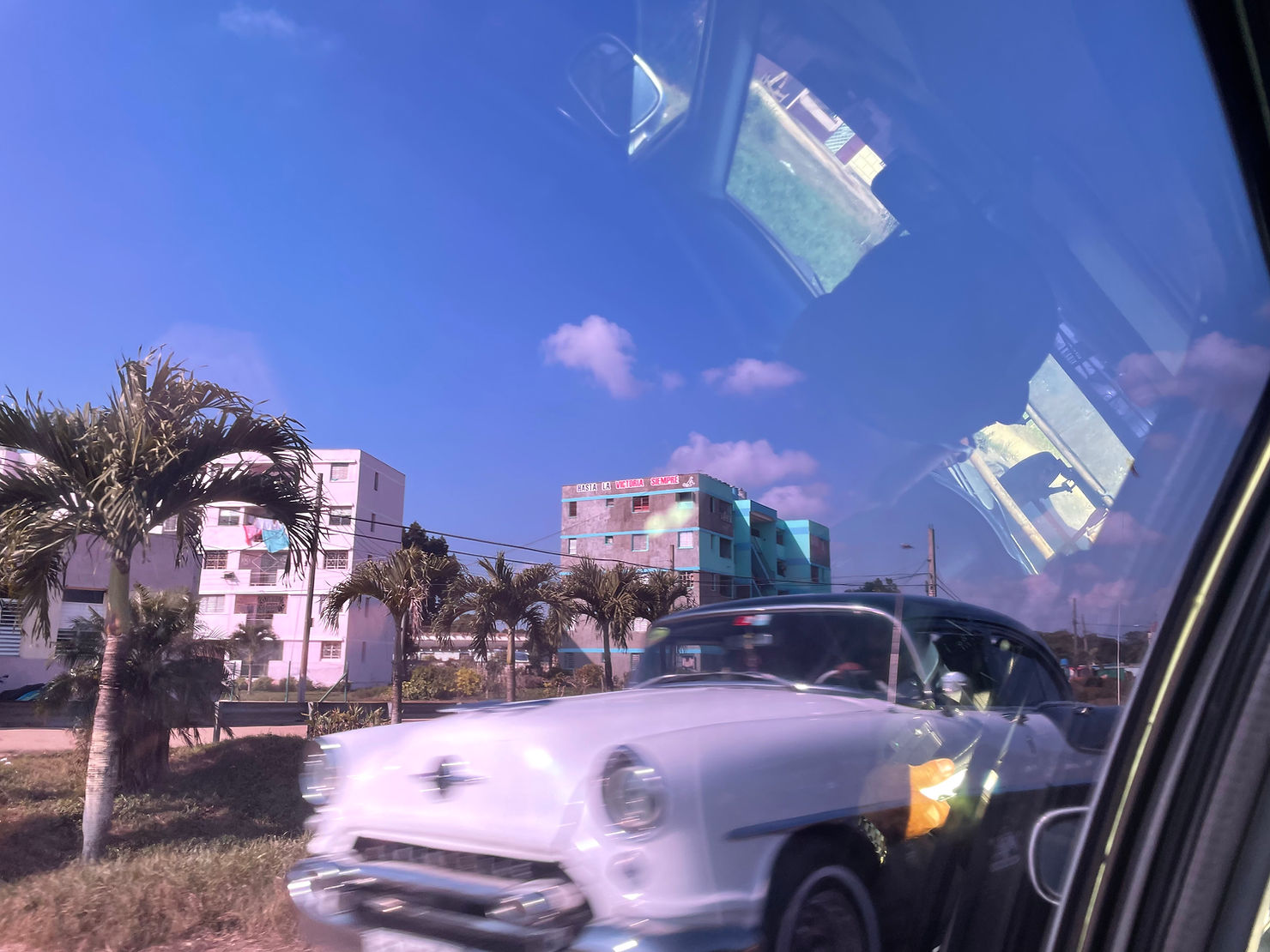
The straight answer is: not at all. I’ve been home for weeks now, and I still find myself reflecting on how incredible this whole experience has been. It’s not just like going back in time, which is what people often say, because of the Chevrolet cars from the 50’s (same decade as las estrellas) or because having phone network is anything but granted. It’s not like visiting any developing country, as Cuba has a very high literacy rate, near-zero homelessness and the highest physicians density in the world. Visiting Cuba is more similar to going to a parallel world, where history has sent people in a different direction, where what we think is simple is difficult and what we think is difficult just keeps happening. You realise Cubans are fighters, and will always be. Their shops might lack everything (including basic medicines), their best way to get goods is through the black market, but regardless of this people will always do what they can to make you feel welcome. They know you’re different and you come from a different place, but they’re happy to tell you about their lives and to listen to what you want to share with them. This might be the best way for them to learn of how the world goes outside of their island.
63 years after the revolution, what remains of it is the propagandistic billboards in every town, the Che Guevara souvenirs tourists buy and the queue Cubans line in to try to get hold of their food rations.
Cubans might have had enough though. The Partido Comunista de Cuba propaganda ensuring continuity between national hero Jose Martì, the Castro Brothers and Diaz-Canel looked like a desperate attempt to remind Cubans of a glorious past that most have never actually witnessed. I kept having the feeling this won’t endure. I’m glad I visited Cuba while I could still experience some results of the ongoing communist experiment. Cuba has a lot to teach to the world. If the current propaganda regime doesn’t allow Cubans to move on and learn from their own country’s lessons, we should not turn a blind eye and be open to learn what this country and their people have to say. And we should consider ourselves lucky to have the possibility to visit such a unique place, while it lasts.
PS: I also made a video, it’s here 🙂
 Claudia